What It Actually Costs to Run a House in the Grand Valley
Most people shopping for a home in Grand Junction compare two numbers: the price of this house against the price of that one. It is the number on the listing, the number the lender cares about, and the number everybody talks about at the kitchen table.
Then they move in, and a second number shows up every month for the next thirty years. Nobody put that one on the flyer.
That second number is not small, and in the Grand Valley it is not evenly distributed. Two houses of the same size, on the same street, at the same price can cost meaningfully different amounts to live in, and the gap does not show up until the first July bill lands. This is a look at where that gap comes from, how to measure it before you sign, and what the local climate does to the math.
At a glance:
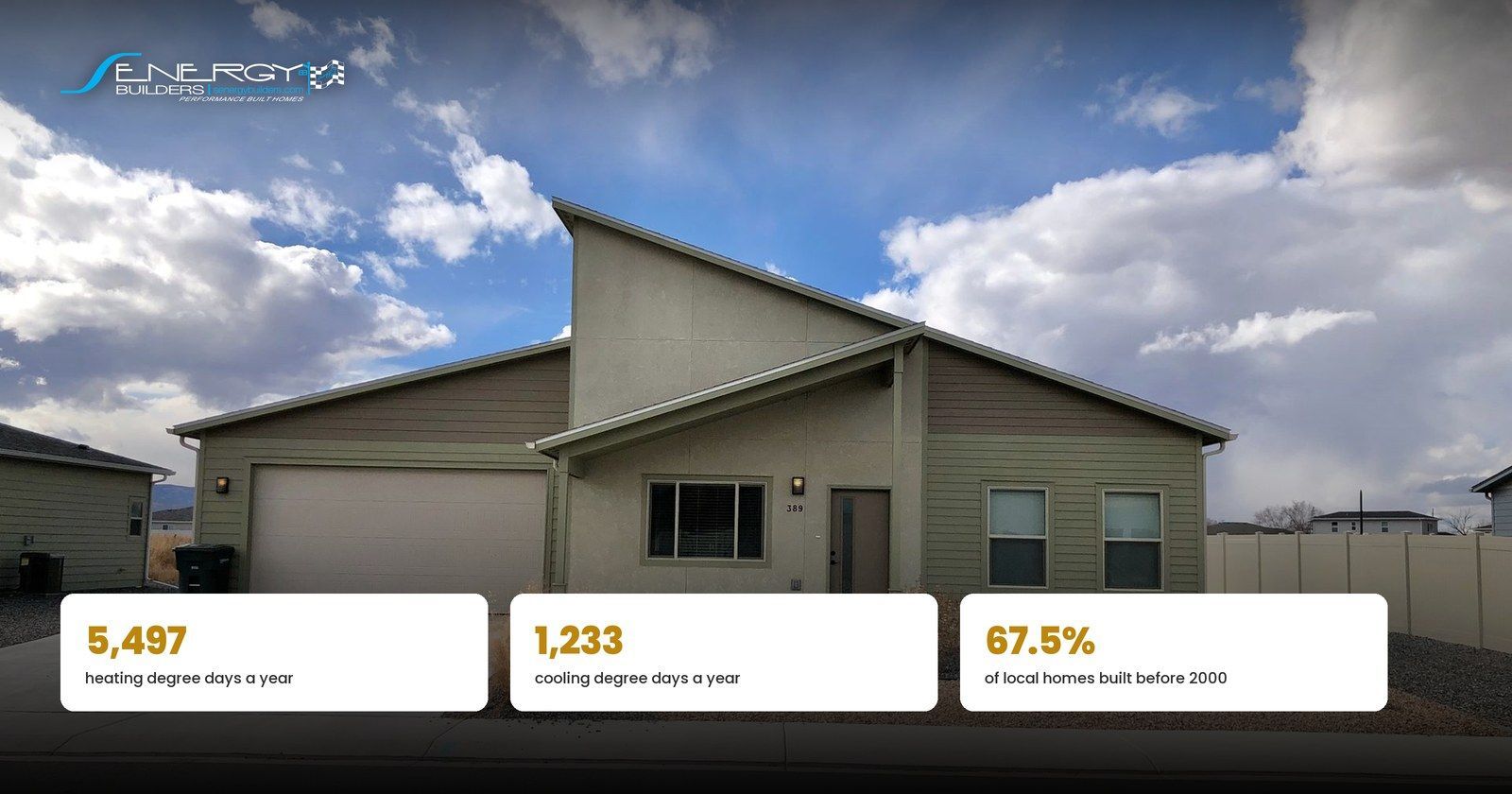
- Grand Junction has a dual-load climate: roughly 5,500 heating degree days and 1,230 cooling degree days a year, so you pay to heat and you pay to cool
- Space heating and air conditioning together account for around 51% of household site energy use nationally
- The median Mesa County home was built in 1988, and 67.5% of local housing units went up before 2000
The number you compare and the number you live with
Purchase price is a one-time negotiation. Operating cost is a subscription you cannot cancel.
Over a typical period of ownership, the running cost of a house can rival the difference in sticker price between the two homes you were choosing from. A buyer who saves $12,000 on the purchase and then spends an extra $90 a month keeping the place comfortable has spent that saving back in about eleven years, and is still paying afterward.
None of this makes a cheaper house the wrong choice. It makes the comparison as usually conducted an incomplete one. The fix is not complicated, but it does mean asking for information that sellers are not in the habit of volunteering.
Why the Grand Valley is a two-season problem
Plenty of American housing markets have one dominant energy season. Phoenix cools. Minneapolis heats. The Grand Valley does both, hard, and that changes what a well-built house needs to do here.
You pay in July and you pay in January
According to NOAA's 1991 to 2020 climate normals for Grand Junction Regional Airport, July here averages a daily high of 94.5°F. January averages a daily high of 38.1°F and a low of 17.3°F.
Run those normals out across the year and you get roughly 5,500 heating degree days and roughly 1,230 cooling degree days. In plain terms, that is a serious heating season stacked on top of a real cooling season, in the same building, on the same envelope.
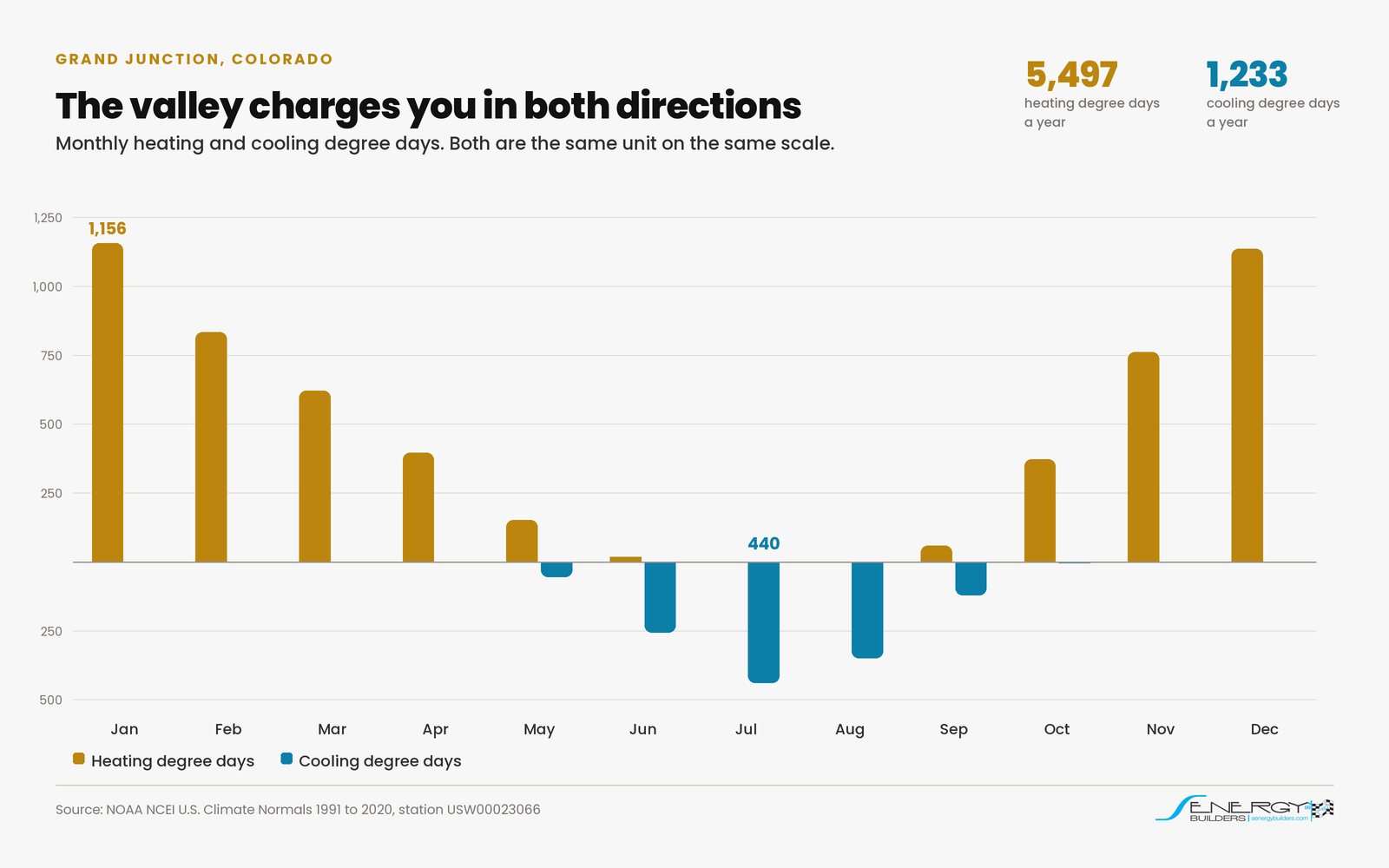
A house that is only good at one of those jobs will cost you in the other. Insulation and air sealing are the two measures that work in both directions, which is why they matter more here than they do in a single-season climate.
The daily swing is the tell
The other feature of a high desert valley is how far the temperature moves inside a single day. In July, Grand Junction's normal high of 94.5°F sits about 31 degrees above the normal overnight low of 63.9°F.
That swing is an opportunity or a liability depending on the house. A tight, well-insulated home coasts through the afternoon on air it cooled overnight and asks the system to do very little. A leaky one loses that cool air by lunchtime and runs the compressor through the hottest part of the day, when demand and rates are at their worst.
Key point: In a climate with a 30-degree daily swing, the quality of the building envelope decides whether the weather works for you or against you.
Most of the valley's housing stock predates the codes that matter
This is not a criticism of older homes. It is a description of the market you are shopping in.
According to
American Community Survey data for Mesa County (2024 one-year estimates), the median year of construction for local housing units is 1988. Of the county's roughly 72,200 housing units, about 67.5% were built before 2000, and 52.6% were built before 1990. Only about 15.8% have gone up since 2010.
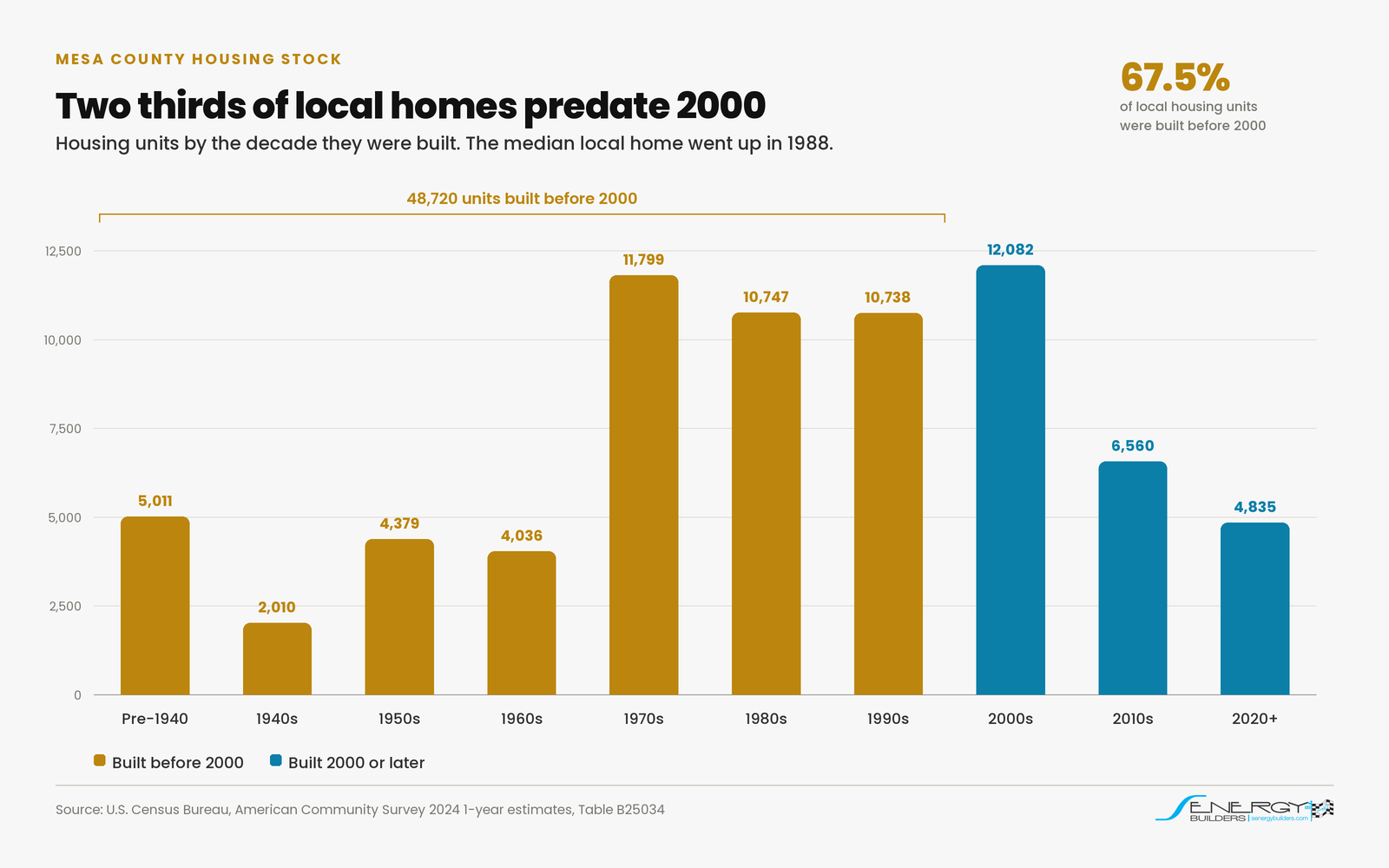
That matters because the energy provisions in residential building code tightened substantially over exactly that period. A house built in 1978 was built to a different standard of insulation, glazing and air sealing than one built in 2018, and no amount of updated countertops changes what is inside the walls.
What ages badly and what does not
Structure ages well. Framing, foundations and roof lines from the 1980s are often in fine shape and were frequently built with material you cannot buy at that price today.
What ages badly is the invisible layer: wall and attic insulation that has settled or was thin to begin with, single-pane or early double-pane windows, ductwork running through unconditioned attics, and the accumulated leaks around every penetration in the shell. The U.S. Department of Energy's own guidance notes that air leakage accounts for a substantial share of the energy used for heating and cooling in a typical residence.
You can fix all of it. Retrofit insulation, air sealing and window replacement are real options and often worth doing. The point for a buyer is that those are costs, and they belong in the comparison alongside the purchase price rather than in a vague mental folder marked "eventually."
Where the money actually goes
Before you can compare two houses properly, it helps to know what you are paying for. Household energy is not spread evenly across everything a house does.
Half the bill is holding a temperature
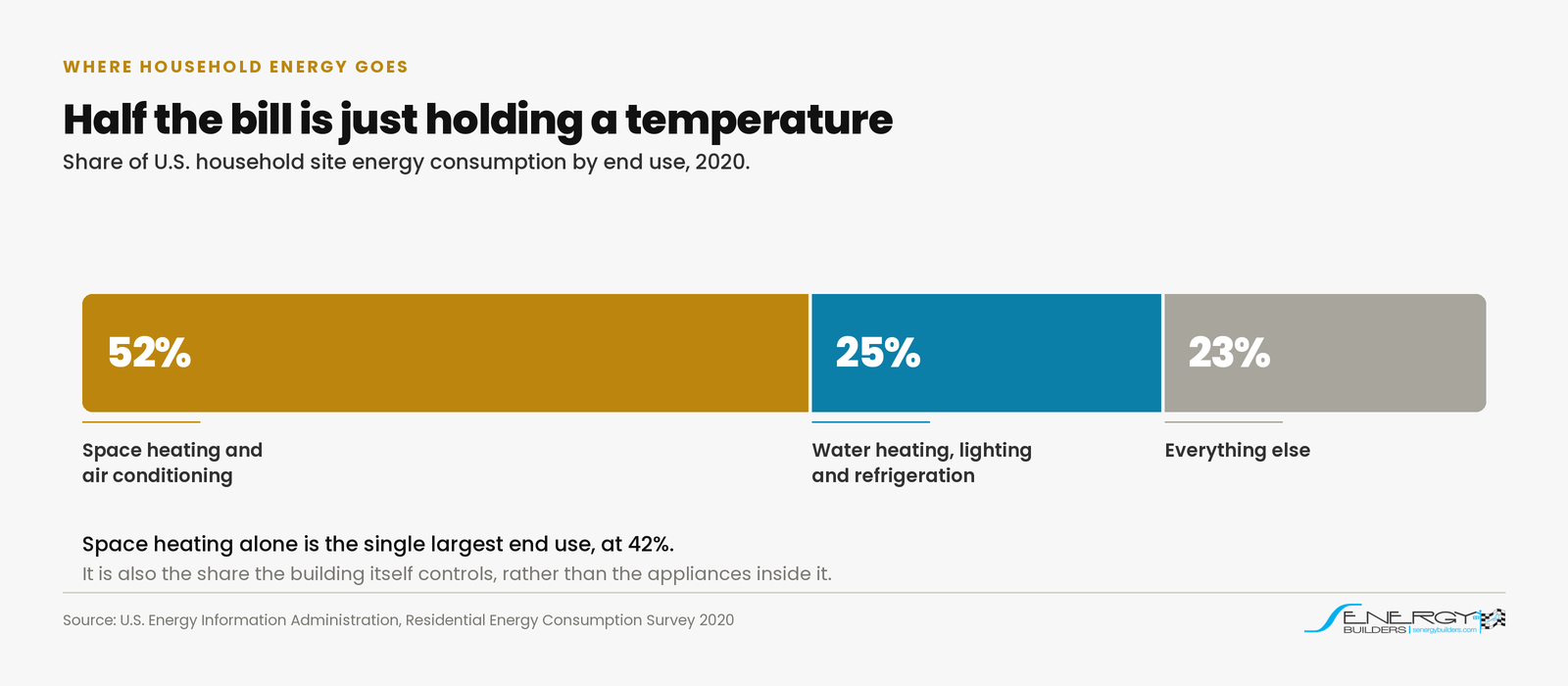
According to the U.S. Energy Information Administration, space heating and air conditioning together accounted for 52% of a household's annual energy use in 2020. Water heating, lighting and refrigeration made up 25%. Everything else, from the dryer to the television to the growing pile of consumer electronics, made up the remaining 23%.
Space heating on its own is
the single largest end use at 42%. In a valley that also runs a real cooling season, that leading share of the bill is the part the building itself controls.
Which is why the envelope decides it
Appliances are a real cost, but you can replace a refrigerator on a Saturday afternoon. You cannot replace what is inside a finished wall.
The measures that move that 52% are insulation, air sealing, glazing and duct work, all of which are settled during construction and awkward to revisit once the drywall is up. Air leakage alone accounts for a substantial share of the energy a typical house spends on heating and cooling.
Key point: The half of your bill the building controls is also the half that is hardest to change after the keys are handed over!
What third-party certification is actually worth
ENERGY STAR certification for a new home is not a sticker the builder awards themselves. EPA requires third-party testing, inspection and certification, which means an independent rater verifies the work rather than taking the builder's word for it.
On performance, EPA's current claim is deliberately conservative: a certified home is "at least 10% more energy efficient than new homes and apartments built to minimum code levels," with additional features contributing further savings. Many certified homes do considerably better than that floor, which is why it is worth asking what a specific house was tested at rather than stopping at whether it carries the badge.
There is a resale argument too. EPA points to studies indicating sales price premiums of up to 8% for ENERGY STAR certified and similarly efficient homes, though as with any market figure that will vary by region and by year.
The part that does not appear on a bill
Efficiency measures are sold on cost, but the reason people notice them is comfort. A tight envelope with good insulation holds temperature evenly, which means fewer cold spots in February and fewer rooms that are unusable between two and six in the afternoon in July.
It also means less dust and pollen pulled in through gaps, and a quieter house, because the same leaks that pass air pass sound. Those are not line items you can put in a spreadsheet, but they are the things owners actually mention.
Where this leaves you
There is no universally correct answer between an older Grand Junction home and a new certified build. There are trade-offs, and they are legitimate ones. Location, lot size, mature landscaping, character and price all count for something real.
What is not legitimate is making the decision on purchase price alone in a market where 67.5% of the housing stock predates 2000 and the climate charges you in both directions. Ask what was verified, ask for the bills, do the arithmetic. The answer might still be the older house, but at least it will be an answer rather than a surprise.
Senergy Builders has been building in the Grand Valley for more than 600 homes, across River Trail, Brookfield South, Canyonview Villas, Cimarron Mesa and Palisades View. If you want to walk through the running-cost math on a specific floorplan, including what the energy certification on that build covers, we will sit down and go through it with you. No obligation, and no pressure to buy anything.
Frequently Asked Questions
How can I tell whether a new home is actually efficient or just marketed that way?
Ask what was independently verified and what was physically tested on the finished house. Certification programs such as ENERGY STAR require third-party testing and inspection rather than the builder's own assessment, so ask whether the home is certified, who carried out the testing, and what the results were. Then put the same question to the older home you are comparing it against, where the answer is usually that nothing has ever been tested. A builder who can tell you exactly what was measured is giving you more than one who uses the word efficient a lot.
Is it cheaper to buy an older home and upgrade it, or buy a new efficient build?
It depends entirely on the specific houses and on how much catch-up work the older home needs. Retrofitting insulation, air sealing and windows is real work at real cost, and it is harder to reach the performance of a purpose-built envelope after the fact because you cannot easily get to everything inside a finished wall. The way to answer it for your situation is to price the upgrade work, add it to the older home's purchase price, then compare total monthly cost of ownership across both options. Sometimes the older home still wins, particularly on location.
Why do heating and cooling matter so much in the Grand Valley specifically?
Space heating and air conditioning together account for 52% of household energy use nationally, and Grand Junction runs both loads hard. NOAA's climate normals put July's average daily high at 94.5°F and January's average low at 17.3°F, which works out to roughly 5,500 heating degree days and 1,230 cooling degree days a year. A house here needs an envelope that performs in both seasons, which is why insulation and air sealing carry more weight locally than any single piece of equipment.
What does Senergy Builders do differently on energy performance?
Senergy builds to energy-efficient standards across its Grand Valley subdivisions, with River Trail built to ENERGY STAR requirements. The practical differences are in the envelope: insulation levels, air sealing detail, window specification and HVAC sizing, all verified rather than assumed. If you want to see the numbers for a specific floorplan, ask what was tested on that build and what the results were, rather than accepting a general statement about efficiency.
You might also like